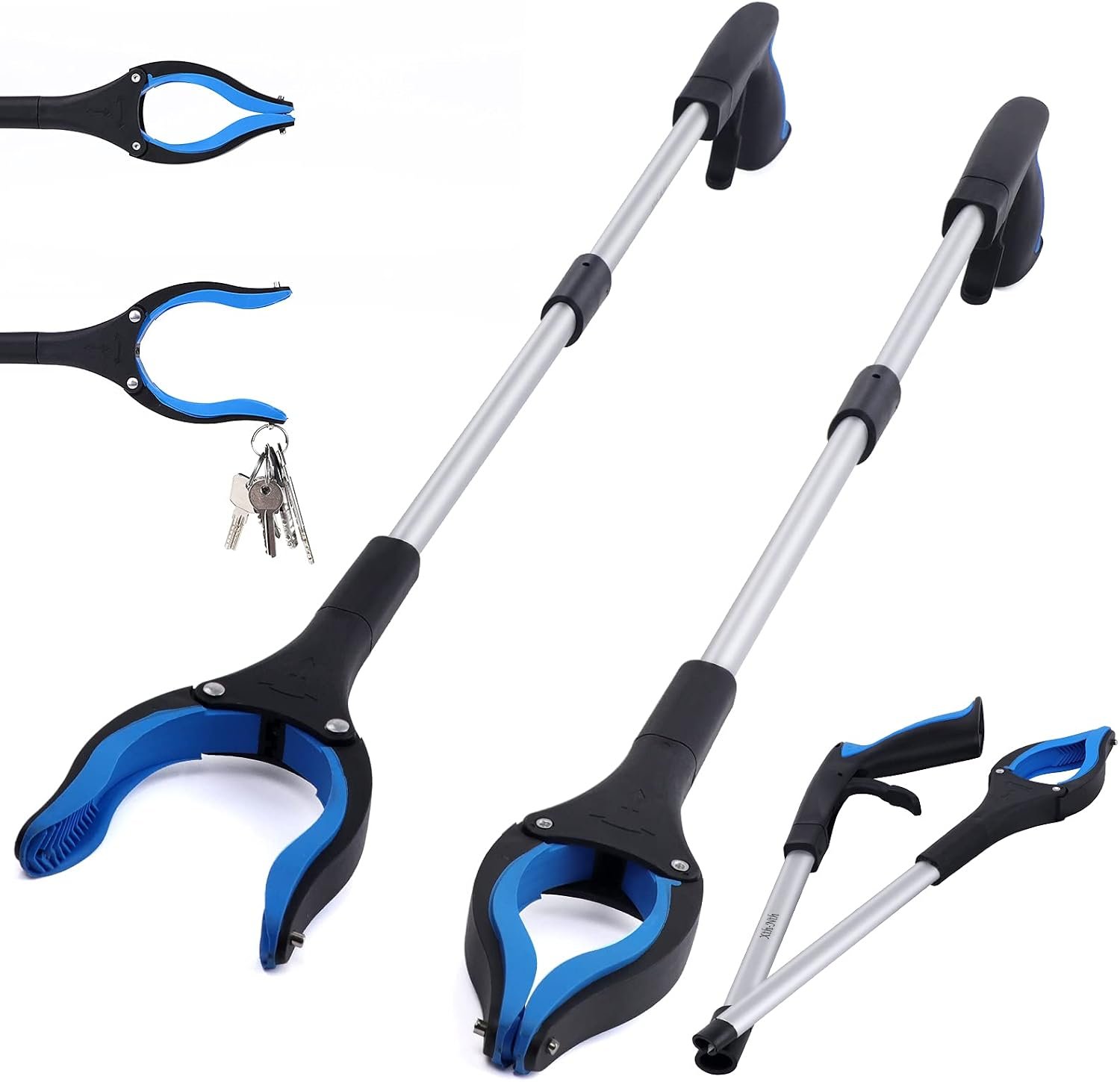
Reaching for a dropped object sounds simple until that object ends up underneath a sofa, behind a cabinet, in a narrow corner, or on the floor when bending down is inconvenient. These small situations happen regularly in homes, offices, garages, gardens, and outdoor spaces. A grabber reacher tool provides an alternative by extending the user’s reach and allowing certain objects to be picked up without direct hand contact.
The 2-Pack Grabber Reacher Tool described in this guide combines several features intended for everyday pickup tasks. Each reacher is 32 inches long and uses a steel construction with a foldable design. The gripping mechanism includes an anti-slip jaw that can rotate through 90 degrees, while a magnetic function provides another way to retrieve certain metal objects.
Having two grabbers in one package can also be practical for households where more than one person may need a reaching tool or where one tool can remain indoors while another is kept in a garage, vehicle, or outdoor area.
As with any household tool, the usefulness of a reacher depends on the task. Lightweight objects with accessible surfaces are generally easier to handle than heavy, fragile, sharp, or hazardous materials. Features such as a rotating jaw and magnet can expand the range of possible applications, but they do not eliminate the need to use the tool within reasonable limits.
This guide explores the main features of the 2-pack 32-inch grabber reacher, common household and outdoor uses, practical handling techniques, important considerations, and differences between general categories of reacher tools.
What Is a Grabber Reacher Tool?
A grabber reacher is a long-handled tool designed to extend a person’s effective reach.
The basic design normally consists of a handle, a long shaft, and a gripping mechanism at the opposite end. Squeezing or operating the handle activates the jaws, allowing the user to grasp a suitable object from a distance.
The concept is useful because many everyday objects are difficult to reach directly.
A dropped item underneath furniture may require someone to bend down and reach into a narrow space. A small piece of litter in a garden may require repeated bending. An object at the back of a deep storage area may be visible but beyond comfortable arm length.
A reacher can help bridge that distance.
The 32-inch length of this particular design provides a substantial extension while remaining relatively manageable for ordinary household applications.
Overview of the 2-Pack 32-Inch Grabber
This grabber set is designed around several practical features: a 32-inch extended length, steel construction, folding capability, a magnetic pickup function, a rotating jaw, and anti-slip gripping surfaces.
The 2-pack format means the set contains two grabber tools. This can be useful when more than one location needs a reacher or when users want to keep one tool in a convenient indoor location and another elsewhere.
The steel construction is intended to provide a sturdy framework for the reacher. The foldable design addresses storage, which can otherwise be a concern with long-handled tools.
The 90-degree rotating jaw introduces flexibility when approaching objects from different angles. Instead of being restricted to a single fixed orientation, the gripping end can be adjusted to suit the position of the object.
The magnetic feature provides an additional method for retrieving suitable metallic items.
Together, these features make the grabbers suitable for a range of light-duty reaching and pickup situations, although users should always consider the weight and characteristics of an object before attempting to move it.
Key Features
32-Inch Extended Reach
The 32-inch shaft gives the user additional reach compared with a normal hand.
This can be particularly useful when an object is located on the floor, underneath furniture, behind an obstacle, or inside a deeper storage area.
For example, someone might drop a remote control underneath a bed. Rather than moving the bed or reaching underneath it manually, a long-handled grabber can potentially bring the item toward the edge.
The same principle applies to lightweight objects on the floor. A reacher can allow a person to collect suitable items while remaining upright.
Longer reach also means greater distance between the user’s hand and the object. This can be convenient, but it may require slightly more precise positioning because the gripping end is farther away.
Steel Construction
The grabbers use steel as part of their construction.
Steel is commonly used in reaching tools because it can provide a rigid shaft and support the movement of the gripping mechanism.
The material is one factor in the overall durability of a tool, but construction material alone does not determine the maximum load that can safely be handled.
A steel reacher should not automatically be treated as a heavy-load lifting device. The appropriate use depends on the specific design, object weight, grip, and manufacturer’s stated limitations.
For ordinary household pickup tasks, the more important consideration is whether the object can be comfortably and securely controlled.
Foldable Design
A 32-inch reacher can be useful while extended, but its length may create storage challenges.
The foldable construction provides a way to make the tool more compact when it is not being used.
This can be especially convenient in smaller homes, apartments, closets, garages, utility rooms, or vehicles.
A folding reacher can also be easier to transport. Someone who uses one tool indoors and another outdoors may find the reduced folded size more convenient when carrying or storing it.
The folding mechanism should be operated according to the manufacturer’s instructions. It should not be forced, twisted, or used as a point for applying excessive pressure.
90-Degree Rotating Jaw
One distinctive feature of this grabber design is the 90-degree rotating gripping head.
A fixed jaw can sometimes be difficult to position when an object is lying at an unusual angle. A rotating jaw provides more flexibility by allowing the user to change the orientation of the gripping end.
This can be useful when retrieving objects from corners, narrow spaces, underneath furniture, or areas where approaching the item directly is difficult.
The rotating feature is particularly relevant to precision. Instead of changing the entire position of the user’s body to align with an object, the gripping head can be adjusted to a more useful angle.
However, rotation does not guarantee that every object will be easier to pick up. The item’s size, shape, and surface still determine how effectively the jaws can hold it.
Anti-Slip Jaw
The gripping surfaces are designed to help prevent objects from sliding out of the jaws.
Anti-slip surfaces can be useful when handling objects with relatively smooth or uneven surfaces.
The goal is to provide better contact between the gripping mechanism and the object.
Even with an anti-slip design, positioning remains important. A poorly positioned object can still slip, especially if it is heavy, rounded, wet, or unusually shaped.
For the most controlled pickup, the user should position the jaws around a stable part of the object and close them gradually.
Magnetic Pickup Function
The integrated magnetic feature provides another method for retrieving certain objects.
A magnet can be useful when an appropriate metal object is too small or awkward to grasp mechanically.
For example, a small magnetic metal item that falls beneath furniture may be easier to retrieve with the magnet than with the claw.
The magnetic function has an obvious limitation: not all metals are attracted to ordinary magnets. Plastic, wood, glass, aluminum, and many other materials will not behave like magnetic iron or steel objects.
The magnet should therefore be viewed as a specialized convenience rather than a replacement for the gripping jaws.
Two-Piece Set
The 2-pack format provides two reacher tools rather than one.
This can be useful for households with multiple floors, storage areas, or outdoor spaces.
For example, one grabber could remain in a utility room while the second is stored in a garage or vehicle.
A second tool can also be useful when two people need a reacher at the same time.
Having a spare can be convenient as well, particularly for tools used regularly in both indoor and outdoor environments.
How the Grabber Can Be Used Around the Home
Picking Up Items From the Floor
Picking up objects from the floor is one of the most straightforward applications.
Lightweight items such as clothing, paper, packaging, plastic objects, and similar household items can often be approached with a long-handled grabber.
The user can remain standing while positioning the jaws around the item.
This can be especially convenient when several objects need to be collected.
Instead of repeatedly bending down, the user can use the reacher to bring the items closer.
Retrieving Objects Under Beds and Sofas
Furniture creates many spaces where objects can become difficult to reach.
Remote controls, toys, clothing, small household accessories, and other items can slide underneath beds or sofas.
A 32-inch reacher can extend underneath the furniture while keeping the user’s hand outside the narrow space.
The rotating jaw may be particularly useful in these situations because the object may not be positioned directly in front of the user.
Before reaching underneath furniture, inspect the area when possible. Electrical cords, sharp objects, fragile materials, or other hazards may be hidden from view.
Reaching Behind Cabinets
Small objects can also fall behind cabinets or other furniture.
A long grabber can potentially reach into these spaces and retrieve suitable items.
The user should avoid blindly probing areas that cannot be inspected. A reacher provides distance, but it does not provide visibility into an inaccessible space.
Accessing Deep Shelves
Deep cabinets and shelves can sometimes place lightweight objects outside comfortable arm reach.
A grabber can provide additional distance for retrieving an item from the back.
Care is important when shelves contain multiple objects. Pulling one item forward can disturb other items and cause them to fall.
Picking Up Lightweight Household Debris
The grabber can also be useful during basic household cleanup.
Small pieces of paper, lightweight packaging, or other suitable debris can potentially be collected without direct hand contact.
This may be particularly useful for users who prefer not to repeatedly bend down during cleanup.
Outdoor Applications
Collecting Litter
A long-handled grabber can be useful for picking up lightweight litter around outdoor areas.
Driveways, patios, gardens, garages, and other spaces can accumulate small pieces of trash.
The extended handle allows the user to remain upright while collecting appropriate objects.
However, sharp or hazardous waste should not automatically be handled with a household grabber. Objects such as broken glass, needles, chemicals, or unknown materials require appropriate safety procedures and protective equipment.
Garden Cleanup
A reacher can also assist with light garden cleanup.
Small pieces of plastic, paper, leaves, and other lightweight objects can sometimes be collected using the gripping jaws.
The rotating head can make it easier to approach objects positioned between plants or near garden edges.
Handling Lightweight Weeds
A grabber can potentially be used to grip certain weeds.
The longer handle allows the user to remain farther from the ground, which can be useful when bending or kneeling is inconvenient.
However, weed removal is different from simply picking up a lightweight object.
A deeply rooted plant may require substantial pulling force. If a weed does not move with moderate pressure, forcing the grabber may place unnecessary stress on the tool.
A dedicated garden weeder or hand cultivator may be more appropriate for difficult plants.
Using the Magnetic Feature
The magnetic function can be useful in specific situations.
Suppose a small metal item rolls underneath a cabinet. If the item is magnetic, the magnet may allow the user to retrieve it without trying to position the jaws around something very small.
Magnetic retrieval works best when the object is close enough for the magnet to make effective contact.
The object’s material also matters. Not every metal is magnetic.
It is also important to remember that a magnet does not necessarily provide the same control as a mechanical claw. Once an item is attracted to the magnet, it may still swing or detach if the tool is moved too quickly.
Slow movements are generally preferable.
Making Use of the Rotating Jaw
The 90-degree rotating jaw can be helpful when an object is positioned at an awkward angle.
Imagine a small object lying sideways against a wall or underneath a piece of furniture. A fixed claw may need the user to approach from a specific direction.
A rotating head provides more freedom.
The user can adjust the gripping end to align with the object, then operate the handle while maintaining a comfortable body position.
This can be particularly useful in corners and narrow spaces.
The rotating feature can also be useful for picking up flat objects. Adjusting the jaw orientation may make it easier to approach an item from the edge rather than directly from above.
Who May Find a Reacher Tool Useful?
Older Adults
Extended reachers can be useful for older adults who want an alternative to repeated bending during simple household tasks.
Picking up lightweight objects from the floor can become less convenient when someone has difficulty bending or stretching.
A long-handled grabber provides another way to perform the task while remaining upright.
Individual comfort varies, however. Users should consider hand strength, grip control, balance, and the weight of the objects they intend to handle.
People With Temporary Movement Restrictions
A grabber can also be useful when certain movements are temporarily inconvenient.
For example, someone may want to avoid repeated bending or kneeling during a recovery period.
A reacher can potentially make simple retrieval tasks easier.
However, anyone recovering from surgery or another medical procedure should follow their healthcare professional’s instructions. A grabber does not make lifting, pulling, bending, or reaching automatically safe.
Caregivers
Caregivers may find reacher tools useful when assisting someone with everyday object retrieval.
A long handle can provide additional distance and reduce the need to reach into difficult spaces.
Having two tools can also make a 2-pack practical for shared households or separate locations.
Homeowners
For general household use, a reacher can be a useful utility item.
Objects frequently fall behind furniture or onto the floor, and a long-handled grabber can provide a convenient way to retrieve them.
People Who Perform Outdoor Cleanup
Anyone who regularly collects lightweight litter may find a long-handled grabber useful.
It can reduce the number of times a person needs to bend down while cleaning an outdoor area.
Important Things to Consider
Object Weight
Weight is one of the most important factors.
A grabber should generally be used for objects that can be safely controlled.
Even if the jaws successfully close around an object, lifting it may place considerable stress on the tool and the user’s wrist or arm.
A long shaft can increase leverage, making a heavier object more difficult to control.
Unless the manufacturer provides a specific load capacity, it is prudent to keep applications focused on lightweight and manageable objects.
Object Size
The gripping jaws need enough room to make effective contact.
Extremely large objects may not fit properly between the jaws.
Very small objects can also be challenging because there may not be enough surface area to create a stable grip.
Object Shape
Shape affects how well an item can be held.
Objects with handles, edges, rims, or textured surfaces may be easier to retrieve than smooth, round objects.
The rotating head can help with orientation, but it cannot overcome every limitation created by the object’s shape.
Surface Texture
Smooth or wet objects may be more difficult to hold securely.
The anti-slip jaw can help with contact, but users should still use controlled movements.
If an object repeatedly slips, reposition the jaws instead of continuously increasing pressure.
Hand Strength
Operating a mechanical grabber requires hand movement.
Anyone with limited grip strength should consider how much force is needed to operate the handle.
A reacher can only be useful if the user can comfortably control the gripping mechanism.
Length and Maneuverability
A 32-inch reach provides useful distance, but it can also make the tool slightly less maneuverable in cramped areas.
A long tool may be excellent for reaching underneath furniture but less convenient when working in a crowded cabinet.
Choosing the right length depends on the intended environment.
Folding Mechanism
Folding construction is convenient for storage, but it introduces a moving component.
Users should ensure the grabber is properly extended and positioned before applying force.
The folding mechanism should not be used to support loads beyond the tool’s intended application.
Comparing General Categories of Grabber Tools
Different types of reachers serve different purposes.
Fixed-Length Grabbers
Fixed-length models use a rigid shaft.
They can be straightforward to operate and may be suitable for people who have enough storage space.
Their main limitation is that a long fixed shaft can be inconvenient to transport and store.
Folding Grabbers
Folding models address the storage problem.
They can be particularly convenient for apartments, smaller homes, vehicles, or people who move the tool between locations.
The 2-pack design discussed here combines folding construction with a relatively long 32-inch reach.
Rotating-Head Grabbers
Rotating-head models provide additional positioning flexibility.
The gripping mechanism can be adjusted to approach objects from different angles.
This can be useful for furniture gaps, corners, and objects lying in unusual positions.
Magnetic Grabbers
Magnetic models add a specialized pickup method.
They can be useful for appropriate small metal objects.
The main limitation is material compatibility. Magnetic retrieval only works with objects that respond sufficiently to the magnet.
Heavy-Duty Grabbers
Some reachers are designed for more demanding applications.
These may have reinforced construction or specialized gripping mechanisms.
However, heavy-duty construction can increase the tool’s weight and may require more effort to operate.
The appropriate category depends on the actual task rather than the strength-related wording used in product marketing.
Tips for Better Results
Positioning is often more important than force.
When approaching an object, look for a stable point to grip.
If the object has a handle, edge, or rim, that area may provide better control.
For flat objects, approaching from the edge may work better than trying to squeeze the object from the center.
For round objects, center the jaws as much as possible.
When using the rotating function, adjust the head before attempting to close the jaws.
Once an object is secured, move slowly.
Avoid swinging the reacher from side to side because the object may become unstable.
If an item does not move easily, stop and reassess rather than applying excessive force.
Maintaining the Grabber
Basic maintenance can help keep the tool ready for regular use.
After outdoor applications, check the jaws for dirt, mud, plant material, or other debris.
Remove material caught around moving components before folding and storing the tool.
Keep the mechanism reasonably clean and dry.
When folding or unfolding the grabber, use the intended mechanism rather than forcing the shaft.
If the jaws begin to operate differently, investigate the cause instead of repeatedly applying more pressure.
For a two-piece set, storing the tools in separate designated locations can also make them easier to find when needed.
Safety Considerations
A grabber provides additional reach, but it should not be considered a safety device for every situation.
Do not use an ordinary household grabber to handle live electrical components.
Avoid using it on hot objects, corrosive substances, chemicals, broken glass, needles, or unknown hazardous materials.
Be cautious when retrieving objects from high shelves. Pulling a heavy or unstable object toward yourself can cause it to fall.
A reacher is also not a substitute for a stable ladder. If an item is too high to reach safely, proper access equipment should be used.
When working outdoors, consider the possibility of insects, sharp vegetation, animal waste, or other hazards hidden around the target object.
The safest use is generally one where the object is visible, lightweight, and easy to control.
Frequently Asked Questions
How long are the grabbers in this set?
The reachers are described as 32 inches long, providing additional reach for everyday pickup and retrieval tasks.
How many grabbers are included?
The product is presented as a 2-pack, providing two grabber reacher tools.
Are the grabbers foldable?
Yes. The design includes a folding feature intended to make storage and transportation more convenient.
Does the gripping head rotate?
Yes. The gripping jaw is designed to rotate through 90 degrees, allowing the user to adjust the orientation of the gripping end for different situations.
What is the purpose of the rotating jaw?
The rotating jaw can make it easier to approach objects from different directions. This may be useful when retrieving items from corners, underneath furniture, or other awkward positions.
Does the grabber have a magnet?
Yes. The design includes a magnetic pickup function for suitable magnetic metal objects.
Can the magnet pick up every metal?
No. Magnetic response varies by material. Many metals are not attracted to ordinary magnets, so the magnetic function is intended only for compatible objects.
What can a 32-inch grabber be used for?
It can be useful for retrieving lightweight household objects, picking up suitable litter, reaching beneath furniture, accessing difficult corners, and handling certain lightweight outdoor items.
Can seniors use this type of grabber?
A long-handled reacher may be useful for older adults who want to reduce repeated bending or stretching during appropriate household tasks. Individual hand strength and control should be considered before use.
Can it be used after surgery?
A grabber may be convenient during a recovery period when bending or reaching is restricted, but medical instructions should always take priority. Anyone recovering from surgery should follow their healthcare professional’s specific restrictions.
Can it pick up heavy objects?
The presence of a steel shaft or anti-slip jaw does not mean the tool should be used for heavy lifting. Unless a specific load capacity is provided, it is more appropriate to use the reacher for lightweight, manageable objects.
Can it be used for trash pickup?
Yes, it can be suitable for lightweight litter and ordinary cleanup tasks. Sharp, hazardous, contaminated, or unknown materials should be handled using appropriate safety equipment and procedures.
Can it be used in a garden?
It can be useful for certain lightweight garden cleanup tasks and may assist with accessible weeds. Difficult or deeply rooted weeds may require a dedicated gardening tool.
Is a folding grabber useful for small spaces?
Folding construction can make a long reacher easier to store in closets, garages, utility rooms, vehicles, or other areas where a full-length tool would take up too much space.
Are two grabbers useful?
Having two tools can provide flexibility. One can be stored indoors while another is kept in a garage, vehicle, or outdoor area. It can also be useful when multiple people need a reacher.
What types of objects are easiest to pick up?
Lightweight objects with stable edges, handles, or reasonably textured surfaces are generally easier to grip. Very heavy, slippery, fragile, tiny, or irregular objects can be more challenging.
Can a reacher replace a ladder?
No. A grabber is designed to extend reach, not to provide safe climbing access.
Conclusion
A 2-pack of 32-inch grabber reacher tools can provide a practical solution for everyday situations where additional reach is useful.
The extended length allows users to access objects beyond normal arm reach, while the foldable construction can make storage and transportation easier. The 90-degree rotating jaw adds flexibility when approaching objects from different angles, and the anti-slip gripping surfaces are intended to help maintain contact with suitable objects. The magnetic feature provides another option for retrieving compatible metal items.
These characteristics can make a grabber useful in many ordinary situations, from retrieving objects underneath furniture to collecting lightweight litter and performing simple outdoor cleanup. For older adults, caregivers, homeowners, or anyone who wants to reduce unnecessary bending during suitable tasks, an extended reacher can serve as a convenient household aid.
At the same time, the tool has practical limitations. Object weight, size, shape, surface texture, and location all influence how successfully it can be used. A long reacher should not be treated as a replacement for lifting equipment, a ladder, specialized gardening tools, or protective equipment for hazardous materials.
The 2-pack format also provides flexibility for households where having a reacher in more than one location is useful. One can remain inside while the other is available for garage, vehicle, or outdoor tasks.
Ultimately, the usefulness of an extended grabber comes from matching its capabilities to appropriate everyday jobs. When used for visible, manageable objects and operated with controlled movements, a 32-inch folding reacher can be a practical addition to a household’s collection of basic utility tools.
Leave a Reply