Everyday objects do not always end up in convenient places. A remote control can slide underneath a sofa, clothing can fall behind furniture, small items can roll into a corner, and lightweight debris can accumulate in areas that are awkward to reach. For someone who wants to avoid repeated bending, kneeling, or stretching, even these simple tasks can become inconvenient.
A grabber reacher tool provides a straightforward way to extend the user’s reach. Instead of reaching an object directly with a hand, the user operates a handle connected to a longer shaft and a gripping mechanism. This makes it possible to retrieve many suitable objects from a distance while remaining in a more comfortable position.
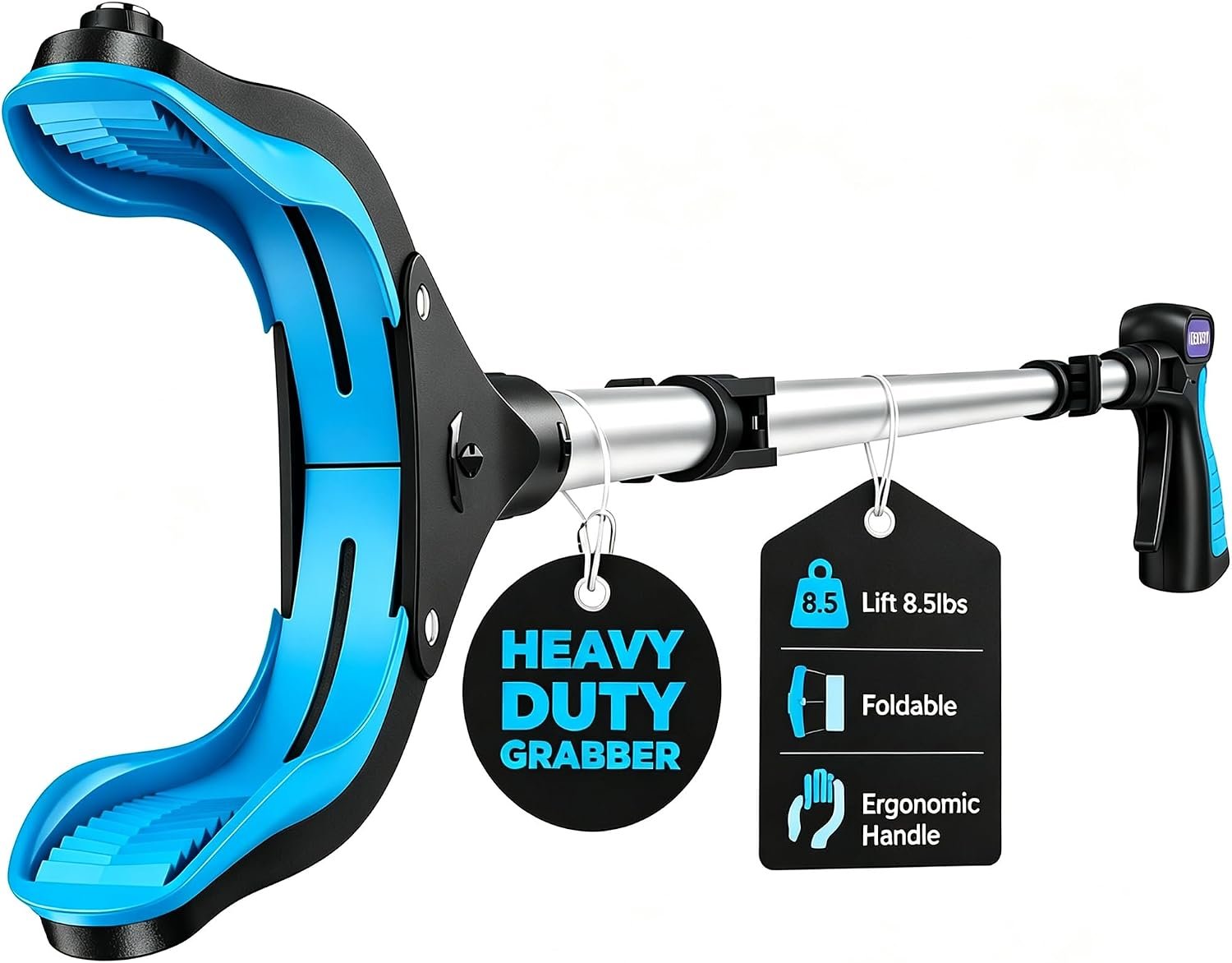
The KEKOY Grabber Reacher Tool is a 40-inch foldable model designed for reaching and pickup applications. Its longer shaft provides additional reach compared with shorter household grabbers, while the foldable construction is intended to make storage and transportation more manageable.
Long reachers can be useful for older adults, caregivers, homeowners, people with temporary movement restrictions, and anyone who regularly encounters objects in difficult-to-reach locations. At the same time, a longer reach does not make a tool suitable for every situation. Object weight, shape, surface, and the user’s ability to control the tool all matter.
This guide explains the practical characteristics of a 40-inch grabber, common ways it can be used, situations where it may be suitable, important limitations, and how it compares with other general categories of reaching tools.
What Is a Grabber Reacher Tool?
A grabber reacher is a long-handled device designed to extend a person’s effective arm reach.
The basic mechanism consists of three main elements: a handle, a shaft, and a gripping head.
When the user operates the handle, the gripping head closes around an object. Depending on the particular design, the jaws may have textured surfaces or other features intended to help maintain contact.
This arrangement can make ordinary retrieval tasks easier.
For example, if a small object falls underneath a bed, the user may not need to reach underneath the furniture with their hand. Instead, the grabber can extend into the available space and bring the object closer.
The same concept can be applied to objects on the floor, behind furniture, inside deep storage spaces, or in other locations where direct access is inconvenient.
A 40-inch reacher provides a relatively substantial extension, making it particularly relevant when additional distance is more important than maximum compactness.
Overview of the KEKOY 40-Inch Grabber
The KEKOY grabber is designed as a long-handled reaching and pickup tool with a 40-inch shaft and foldable construction.
The extended length is intended to help users access objects that are beyond comfortable arm reach. This can be useful for floor pickup, retrieving objects underneath furniture, and other household tasks.
The folding feature addresses one of the common disadvantages of long-handled tools: storage.
A rigid 40-inch tool can be awkward to place inside a small closet or cabinet. A foldable design can make it easier to store when it is not being used and may also simplify transportation.
The product is positioned as a grabber for seniors, but the concept is not limited to older adults. Anyone who wants additional reach for appropriate lightweight tasks may find a long-handled reacher useful.
It is important, however, to distinguish a household reaching aid from specialized lifting equipment. The fact that a tool has a long shaft or is described as heavy duty does not mean that it should be used to lift every heavy object that fits inside its gripping mechanism.
Key Features
40-Inch Extended Reach
The 40-inch length is one of the defining characteristics of this grabber.
Compared with shorter reachers, a 40-inch model can provide additional distance when an object is farther away.
This can be particularly helpful when reaching underneath furniture. A longer shaft allows the user to access farther into the space without placing an arm directly beneath the furniture.
The extra length can also be useful when picking up objects from the floor.
Instead of bending down for every item, the user can operate the grabber from a standing position.
The increased reach does come with a trade-off. A longer shaft can be somewhat more difficult to maneuver precisely, especially in crowded rooms or narrow spaces.
For that reason, users should approach objects slowly and make deliberate movements.
Foldable Construction
Long reachers can be inconvenient to store because of their overall length.
The foldable design of the KEKOY model provides a practical way to reduce its size when it is not in use.
This can be helpful in homes with limited storage space.
A folded grabber may be easier to place in a closet, utility room, garage, vehicle, or other storage location than a rigid 40-inch tool.
Foldability can also be useful when transporting the reacher.
However, the folding joint should be handled according to the manufacturer’s instructions. Users should avoid forcing the mechanism or treating the joint as an area for applying additional leverage.
Long-Handle Reaching Design
The extended handle allows the user to interact with objects from a greater distance.
This can reduce the need for bending or stretching during appropriate pickup tasks.
The principle is simple: rather than bringing the user’s body closer to the object, the tool brings the object closer to the user.
That can be useful in many everyday situations.
However, the reaching mechanism is most appropriate for objects that can be safely controlled with the gripping head.
Gripping Mechanism
The gripping head determines how effectively the reacher can interact with objects.
A mechanical grabber generally works by positioning the jaws around an item and closing them through the handle mechanism.
The shape and texture of the object can make a significant difference.
Objects with edges, handles, or relatively firm surfaces may be easier to hold than smooth, round, flexible, or very thin objects.
A successful pickup often depends more on positioning than on squeezing force.
Users should try to center the object between the gripping surfaces whenever possible.
How the KEKOY Grabber Can Be Used
Picking Up Objects From the Floor
One of the most common uses of a reacher is collecting lightweight objects from the floor.
Clothing, paper, small packaging, lightweight household items, and similar objects may be suitable depending on their shape and the gripping mechanism.
The user can remain standing while positioning the grabber around the object.
This can be especially useful when several objects need to be collected.
Instead of repeatedly bending down and standing back up, the reacher can bring suitable items closer.
The tool should not be used automatically for every object on the floor. Heavy objects, sharp materials, fragile items, and unknown substances should be assessed separately.
Retrieving Items Under Furniture
The space beneath beds, sofas, cabinets, and tables is a natural application for a long grabber.
Small objects can easily slide underneath furniture, where they may be difficult to retrieve by hand.
A 40-inch shaft provides enough reach for many such situations.
The user can extend the gripping head underneath the furniture and attempt to grasp a visible object.
If the item is not visible, caution is necessary. Reaching blindly underneath furniture can expose the claw to sharp objects, electrical cords, or other hazards.
Reaching Behind Furniture
Objects can also fall behind desks, cabinets, appliances, or storage units.
A reacher may help retrieve suitable lightweight items from these locations.
Before reaching behind an appliance, users should consider electrical connections, heat, moving parts, and other potential hazards.
A long grabber provides additional distance, but it does not make hazardous environments safe.
Accessing Deep Shelves
Deep storage areas can place objects beyond comfortable arm reach.
A grabber can sometimes retrieve lightweight items from the back of a shelf or cabinet.
This can be particularly useful in closets, garages, utility rooms, and storage areas.
When shelves contain multiple stacked objects, users should be careful. Pulling one item can cause another object to fall.
The reacher is most appropriate when the target object is identifiable and can be removed without disturbing surrounding items.
Outdoor Uses
A long grabber can also be useful outside the house.
Lightweight Litter Collection
Outdoor areas such as patios, driveways, gardens, and garage entrances can accumulate small pieces of litter.
A long-handled reacher can help collect suitable lightweight objects while allowing the user to remain upright.
This can reduce the need for repeated bending during cleanup.
However, not every piece of outdoor waste is appropriate for a household grabber.
Sharp metal, broken glass, needles, chemicals, animal waste, or unknown substances should be handled using appropriate safety equipment and procedures.
Garden Cleanup
A grabber can assist with certain light garden cleanup tasks.
Small pieces of plastic, paper, or other lightweight debris can sometimes be collected with the gripping mechanism.
The extended handle can also make it easier to reach between plants without putting the user’s hand directly into dense vegetation.
Weed Handling
Long grabbers can sometimes be used to handle accessible weeds.
A weed with a manageable stem may be gripped and pulled while the user remains standing.
However, removing a weed from the ground is different from simply picking up an object.
Deeply rooted plants can require considerable pulling force. If a weed does not move with moderate controlled pressure, forcing the grabber may place unnecessary stress on the mechanism.
For difficult gardening work, a dedicated weeding tool may be more appropriate.
Why a Foldable Design Can Matter
Storage is an important consideration for long tools.
A 40-inch reacher provides useful distance, but its full length can make it difficult to store in a small area.
A foldable model can reduce that inconvenience.
For someone living in a smaller home or apartment, being able to fold the tool may make it easier to keep accessible without dedicating an entire closet section to it.
The same applies to vehicles.
Someone who wants to keep a pickup tool in a car, SUV, or recreational vehicle may find a folding design more convenient than a rigid shaft.
Foldability can also make the tool easier to move between rooms.
Who May Find a 40-Inch Grabber Useful?
Older Adults
Long-handled reachers can be useful for older adults who want to reduce repeated bending during everyday activities.
Picking up an object from the floor may be easier with a reacher than with direct hand contact, depending on the individual’s circumstances.
A long handle can also help with objects underneath furniture or in other low positions.
Comfort and control remain important. A person should be able to operate the handle without excessive strain.
People With Temporary Mobility Restrictions
A grabber may also be useful when someone is temporarily avoiding certain movements.
For example, a person may want to reduce bending or kneeling during a recovery period.
An extended reacher can provide another way to retrieve lightweight household items.
However, anyone recovering from surgery should follow their healthcare professional’s specific instructions regarding lifting, bending, stretching, and other movements.
A grabber is a household aid, not medical equipment.
Caregivers
Caregivers may find a long-handled reacher useful for simple retrieval tasks.
The tool can bring an object closer before it is handled directly.
This can sometimes make everyday household assistance more convenient.
Homeowners
A reacher can serve as a general-purpose utility tool.
Objects inevitably fall underneath furniture or into corners, and having a dedicated grabber available can eliminate the need to improvise with unsuitable objects.
People Performing Cleanup
The 40-inch length can be useful for light cleanup around a home, garage, yard, or other area.
Users can collect appropriate lightweight debris while remaining upright.
Important Things to Consider
Object Weight
Weight should always be considered before using a reacher.
A grabber’s ability to close around an object does not automatically mean that the object is safe to lift.
The longer the shaft, the more leverage is involved when an object is held away from the user’s body.
A relatively modest weight can therefore feel more difficult to control at the end of a long tool.
Unless the manufacturer provides a specific load capacity for a particular application, it is sensible to focus on lightweight, manageable objects.
Object Size
The gripping mechanism needs to accommodate the object.
Very large objects may not fit between the jaws.
Extremely small objects can also be difficult because there may not be enough surface area for a stable grip.
Object Shape
Shape has a major influence on gripping performance.
Objects with handles, edges, or defined surfaces can often be easier to grasp.
Round, smooth, or flexible objects may require more careful positioning.
If an object repeatedly slips, changing the angle or gripping location may help.
Surface Texture
Smooth or slippery surfaces can reduce grip.
Wet objects may also behave differently from dry ones.
The safest approach is to use controlled movements and avoid assuming that additional squeezing force will solve every gripping problem.
Hand Strength
The user must be able to operate the handle effectively.
This is particularly important for people considering a grabber as a reaching aid.
A tool that is difficult to squeeze may not be practical for repeated tasks.
Users should pay attention to comfort and stop if operating the tool causes significant discomfort.
Storage Requirements
Although the grabber folds, it still requires an appropriate storage location.
It should be stored somewhere accessible without creating a tripping hazard.
A dry area is generally suitable for storing household equipment.
Fragile Objects
Fragile items require extra caution.
A mechanical claw can exert pressure, and delicate objects can break if handled improperly.
If an object is particularly fragile, users should consider whether direct handling or another retrieval method would be safer.
Hazardous Materials
A grabber does not replace appropriate safety equipment.
Do not assume that a long handle makes broken glass, needles, chemicals, hot materials, or unknown substances safe to handle.
Hazardous materials should be managed using appropriate procedures.
Comparing General Types of Reacher Tools
Different reacher designs serve different needs.
Short Reachers
Short grabbers are usually easier to maneuver and store.
They can be convenient for nearby objects and small household tasks.
Their main limitation is reach. They may not extend far enough underneath furniture or into deep spaces.
Medium-Length Reachers
Medium-length tools offer a compromise between reach and maneuverability.
They can work well for general household pickup while remaining relatively easy to handle.
Long Reachers
Long models such as a 40-inch grabber provide more distance.
They can be useful for reaching farther underneath furniture, retrieving objects from the floor, and performing outdoor cleanup.
The trade-off is that longer tools may require more deliberate control.
Folding Reachers
Folding designs focus on storage and portability.
They can be particularly useful for people with limited storage space or those who want to transport the grabber.
A folding mechanism adds convenience but should be operated carefully.
Rotating-Head Reachers
Some grabbers use a rotating head to change the orientation of the gripping mechanism.
This can be useful for objects located in corners or awkward positions.
The advantage is flexibility rather than necessarily greater gripping strength.
Magnetic Reachers
Magnetic models include a magnet for retrieving suitable metal objects.
This can be useful for small metallic items that are difficult to grip mechanically.
However, magnetic properties vary by material, so the feature is limited to compatible objects.
Tips for Better Pickup Results
Using a reacher effectively often depends on technique.
Start by identifying the easiest part of the object to grip.
If an item has a handle, edge, rim, or thicker section, try positioning the jaws around that area.
For flat objects, approaching from the edge may provide better contact.
For round objects, try to center the gripping mechanism around the middle.
Once positioned, close the jaws gradually.
If the object slips, release it and try a different angle.
Avoid immediately increasing force.
When an object has been secured, move the grabber slowly. Sudden movements can cause the item to swing or fall.
If the object resists movement, stop and reassess.
It may be stuck, too heavy, tangled, or otherwise unsuitable for the reacher.
Maintaining a Foldable Reacher
Basic maintenance can help keep the grabber ready for use.
After outdoor applications, inspect the gripping end for dirt, mud, grass, or other debris.
Remove anything caught around moving components.
Keep the tool reasonably clean and dry before storage.
When folding the grabber, use the intended folding mechanism rather than forcing the shaft.
Avoid placing heavy objects on top of the folded tool.
If the gripping mechanism develops unusual resistance or movement, stop using it until the issue has been identified.
Common Mistakes to Avoid
One common mistake is using a reacher to lift an object that is too heavy.
Another is trying to retrieve something from a hidden area without first checking for hazards.
Users may also attempt to use the tool on objects that are too fragile or slippery for reliable gripping.
A long grabber should not be treated as a substitute for a ladder. If an object is stored too high for safe standing access, proper climbing equipment should be used.
Another important consideration is electrical safety. A standard household grabber should not be used to manipulate live electrical components.
The same principle applies to hot surfaces, chemicals, and other hazardous materials.
Frequently Asked Questions
How long is the KEKOY grabber?
The model described here is a 40-inch grabber reacher, providing extended reach for suitable household and outdoor tasks.
Is the KEKOY grabber foldable?
Yes. The product is designed with a folding construction intended to make storage and transportation more convenient.
What can a 40-inch grabber be used for?
It can be useful for retrieving suitable lightweight objects from the floor, reaching underneath furniture, accessing deep spaces, collecting lightweight litter, and assisting with certain outdoor tasks.
Is a 40-inch reacher suitable for seniors?
An extended reacher may be useful for older adults who want an alternative to repeated bending during appropriate household tasks. Individual hand strength, balance, coordination, and comfort should be considered.
Can it be used after surgery?
A grabber may help with simple retrieval tasks when bending or reaching is temporarily inconvenient. However, people recovering from surgery should follow their healthcare professional’s specific restrictions regarding movement, lifting, bending, and stretching.
Can it pick up heavy objects?
A reacher should not automatically be treated as a heavy-lifting device. Unless the manufacturer provides a specific load capacity for the intended task, it is safer to use the tool for lightweight and manageable objects.
Can it pick up objects from under a bed?
A 40-inch reacher can potentially reach beneath beds, sofas, and similar furniture when there is enough clearance for the gripping mechanism.
Can it be used outdoors?
Yes, a grabber can be useful for suitable lightweight outdoor pickup and cleanup tasks. It should not be used as a substitute for specialized equipment when handling heavy debris, hazardous materials, or difficult landscaping tasks.
Can it be used for weeds?
A long grabber may assist with accessible weeds that can be gripped and removed without excessive force. Deeply rooted or stubborn plants may require dedicated gardening tools.
Does a foldable design make a grabber easier to store?
Folding construction can reduce the space required for storage compared with a rigid tool of the same extended length.
Can it replace a ladder?
No. A reacher extends arm reach but does not provide safe climbing access.
What objects are easiest to pick up?
Lightweight objects with defined edges, handles, or suitable gripping surfaces are generally easier to retrieve than very smooth, heavy, fragile, or irregular objects.
Can it be used to pick up trash?
A grabber can be useful for suitable lightweight litter. Sharp, hazardous, contaminated, or unknown materials should be handled using appropriate safety procedures.
What should I consider before choosing a reacher?
Consider the tool’s length, folding mechanism, handle comfort, gripping design, storage requirements, intended applications, and the types and weights of objects you expect to retrieve.
Conclusion
The KEKOY Grabber Reacher Tool provides a 40-inch extension designed to help users retrieve suitable objects from locations that may be inconvenient to reach directly.
Its extended length can be useful for picking up lightweight objects from the floor, reaching underneath furniture, accessing deeper storage spaces, and performing certain outdoor cleanup tasks. The foldable construction adds a practical storage advantage, especially for users who want the reach of a longer tool without keeping a rigid 40-inch shaft in a storage area.
A long-handled grabber may be particularly useful for older adults, caregivers, homeowners, and people who want an alternative to repeated bending or stretching during appropriate tasks. It can also serve as a general-purpose household utility tool when kept available for unexpected reaching situations.
However, the tool should be used within sensible limits. Object weight, size, shape, surface texture, and location all influence whether the gripping mechanism can handle an item effectively. A grabber should not be considered a replacement for a ladder, heavy lifting equipment, specialized gardening tools, or appropriate protective equipment for hazardous materials.
The 40-inch length provides substantial additional reach, while the folding design can make the tool easier to store and transport. For everyday applications, the most important consideration is whether those characteristics match the user’s environment and the types of objects they need to retrieve.
When used for visible, manageable objects and operated with controlled movements, a foldable long-handled reacher can be a practical addition to a home’s basic collection of utility tools.
Leave a Reply